How to Choose a Robotics Data Collection Company
Evaluating egocentric data providers: collection costs, quality requirements, data rights, and supplier due diligence
A single data collection order can pass through several companies before it reaches the people wearing the cameras. Each company keeps a share of the budget. Meanwhile, the buyer may be unaware that two of its chosen suppliers use the same collection site.
I am the founder of FileMarket. We orchestrate data collection teams across countries for robotics developers and companies building physical AI. We have worked through intermediaries and directly with end customers, giving us a view of this supply chain from several positions.
This article focuses primarily on custom egocentric data collection, the capture of first-person video. A participant performs tasks while wearing a camera, with additional sensors used where the project requires them. We will look at how to choose a supplier, assess its proposal, and evaluate its work before increasing the order volume.
Key criteria for choosing a supplier
- Role in the supply chain. What the company handles in return for its markup: recruitment, equipment, quality checks, financing, and team coordination.
- Feasibility of the requirements. How participant, site, and device restrictions affect pricing and delivery times.
- Quality and acceptance. What counts as a billable hour, who reviews the data, and which defects lead to rejection.
- Data rights and provenance. Who obtains consent and permissions, which rights the buyer receives, and whether the delivery could overlap with other purchases.
- Payment terms. Whether the supplier can keep collecting while waiting for review and payment.
- Pilot results. Whether the supplier has demonstrated consistent quality, delivery rates, error correction, and the ability to onboard additional teams.
Who to Hire for Data Collection and Why Prices Vary
The market can be viewed as a pyramid. At the top are model developers and robotics companies with budgets for data. Below them sit large data companies and integrators, followed by data collection companies, local teams, and individual participants.
Within a single supply chain, the available budget decreases at each level. The company with the direct contract receives the end customer's rate. It retains a portion to cover its work and margin, then uses the remaining budget to hire the next provider. If that provider also subcontracts the collection, the amount decreases again. The person recording the data ultimately receives payment for their participation.
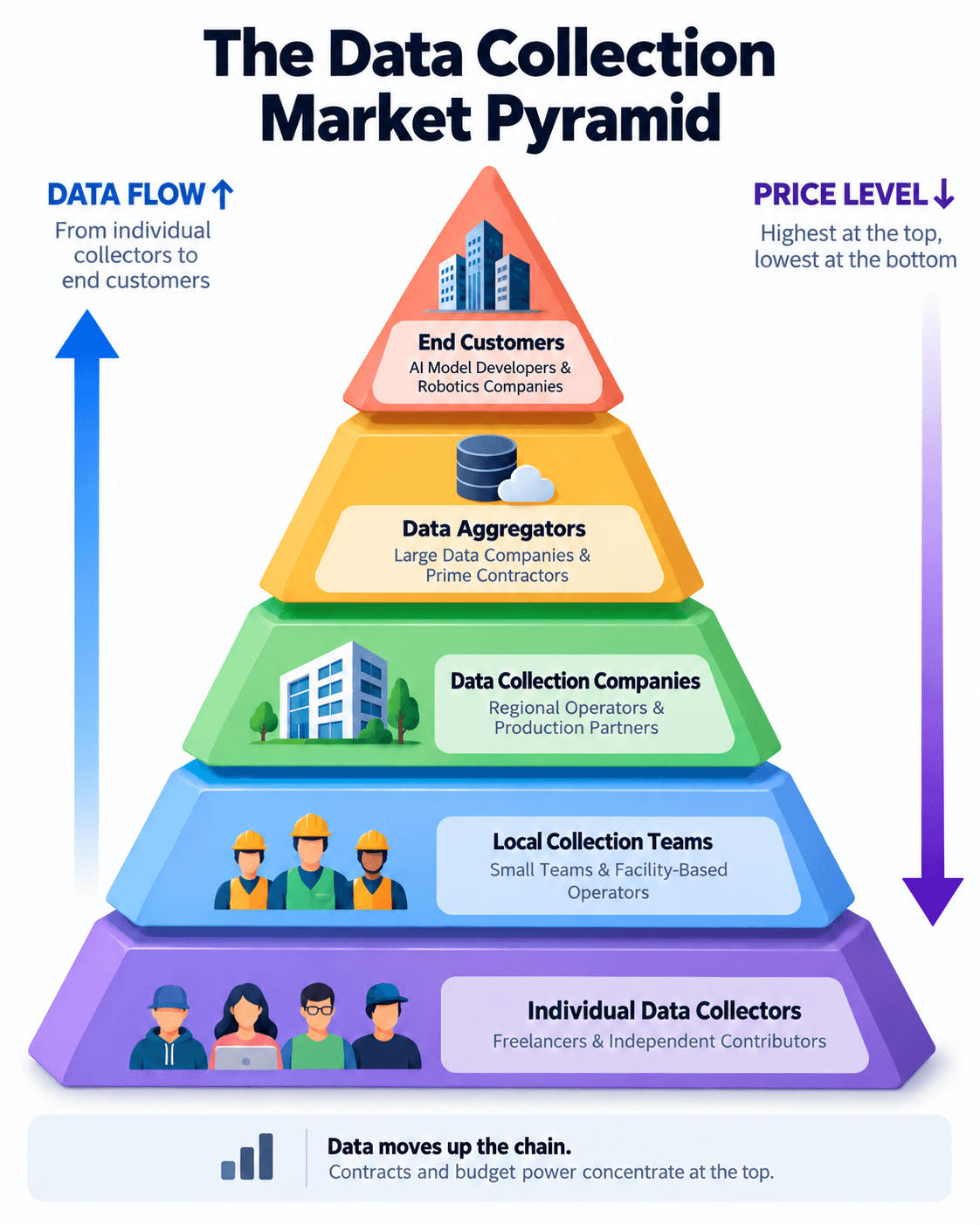
A buyer can work directly with any suitable level of this chain. One company may also perform several roles.
Individual collectors and small teams are a good fit when you already have a process in place: clear tasks, equipment or an app, internal quality checks, and a team to manage participants. This arrangement involves fewer layers of markup. However, attracting, recruiting, training, and replacing participants remain your operational responsibilities. Some collection companies have grown in exactly this way: someone starts recording independently, builds a team, and gradually takes on larger orders.
A local operator is particularly useful when you need access to a specific environment. For example, the founder of a data company may have access to manufacturing facilities through a family business. They already have people, premises, and an understanding of local operations. However, that partner's capacity is limited by the sites and equipment available to them. One team may be insufficient for collection across dozens of different factories.
A managed data collection company finds and coordinates multiple teams, handles equipment, and reviews and prepares the data. This type of partner is useful when the buyer lacks the resources to launch collection sites in several countries and resolve their day-to-day problems.
A large integrator can distribute a substantial order across several data companies, finance the launch, and replace a partner that falls behind. It often does not record any data itself. A higher price is justified when it provides access to collection capacity, funding, and the ability to keep the project running.
Consider a hypothetical project covering Asia, Africa, Europe, and South America. An integrator launches collection with partners in India, Egypt, Poland, and Argentina. The Argentine team falls behind, so part of its volume is reassigned to a partner in Brazil, provided the change meets the client's requirements. This is the value of managing a distributed collection project: having alternatives available and knowing which ones fit the requirements.
If an integrator simply forwards messages to the next contractor, a substantial markup is difficult to justify.
| Your situation | Where to start your search | What to check |
|---|---|---|
| You have an established process and need people to execute it | Individual collectors, small teams, or a BPO partner | Whether your team can handle participant training, supervision, and replacement |
| You need a specific industrial environment | A local operator | Whether the available sites are sufficient given your collection limits |
| You need to launch several teams without managing them daily | A data collection company | Whether it has the resources for coordination, equipment, and quality checks |
| You need a large, distributed collection project with a long review and payment cycle | An integrator | Whether it can finance collection and reallocate volume |
Here, a business process outsourcing (BPO) partner means a company that provides staff and an operational base. The collection organizer may still supply the equipment and technical workflow.
Which Requirements Increase Costs and Can Delay the Launch?
A buyer may have a broad request with few restrictions on participants or environments. In that case, the supplier can use teams and sites it already has available, making it easier to offer a competitive price.
Every mandatory restriction reduces the available options. Some make the project too expensive; others leave no suitable provider able to complete the collection within the required timeframe.
Disclose all mandatory requirements before agreeing on a price and signing a contract. This is especially important for details that may seem minor: participant quotas, maximum hours per person, limits per site, or a particular camera configuration.
How Participant Hour Limits Affect Collection Costs
Suppose you need 1,000 hours of data, with no more than 10 accepted hours from any one person. The supplier will need at least 100 participants. Each must be recruited, trained, and supported until they deliver the required volume.
Even if you know the participant's hourly rate, you cannot calculate the supplier's costs simply by multiplying that rate by the order volume. Consider this hypothetical example:
- A participant receives $5 per paid working hour.
- Recruiting one participant costs $7.50.
- 70% of paid working time becomes accepted footage. The rest goes into preparation, testing, downtime, and re-recording.
- Each participant contributes the full allowance of 10 accepted hours.
| Cost item | Calculation | Result |
|---|---|---|
| Minimum number of participants | 1,000 / 10 | 100 participants |
| Participant recruitment | 100 × $7.50 | $750 |
| Paid working time | 1,000 / 0.7 | Approximately 1,429 hours |
| Participant pay | 1,000 / 0.7 × $5 | Approximately $7,143 |
| Participant pay and recruitment | $7,143 + $750 | Approximately $7,893 |
| Cost per accepted hour of data | $7,893 / 1,000 | Approximately $7.90 |
All figures are illustrative. Equipment, management, and data review costs are excluded. If someone leaves after their first recordings, the supplier will need a replacement and incur additional recruitment costs.
A per-person limit makes recruitment and training recurring expenses. A participant may have learned the instructions and started producing consistent footage just as they reach their contribution limit. For example, a cap of five accepted hours would require at least 200 people. In our calculation, recruitment costs would rise from $750 to $1,500, with the same hourly pay and share of working time converted into accepted footage.
The nature of the opportunity also affects recruitment. A month-long assignment and a short, one-off engagement attract different people. Finding someone willing to complete training for only a few paid shifts can be harder. Restrictions on age, body type, language, and other characteristics further reduce the candidate pool.
If the limit is still provisional, ask the supplier to compare pricing and timelines for several different contribution limits. This will show how much additional participant diversity costs in your project.
How Site Limits Affect Delivery Timelines
Suppose you can accept no more than 100 hours from a single factory. Once that limit is reached, the supplier must onboard another site, even if the original team has become skilled at recording.
Each launch requires agreement with the owner, integration of recording into the site's workflow, and participant training. A factory may be unwilling to invest that effort in a short engagement. Access to several facilities therefore does not necessarily mean a contractor can complete the entire order.
When site limits are strict, you need to understand how the supplier will onboard new locations. It may successfully record samples at a familiar factory and then spend a long time searching for the next one. That transition needs to fit the delivery schedule.

Which Quality Requirements Add Work?
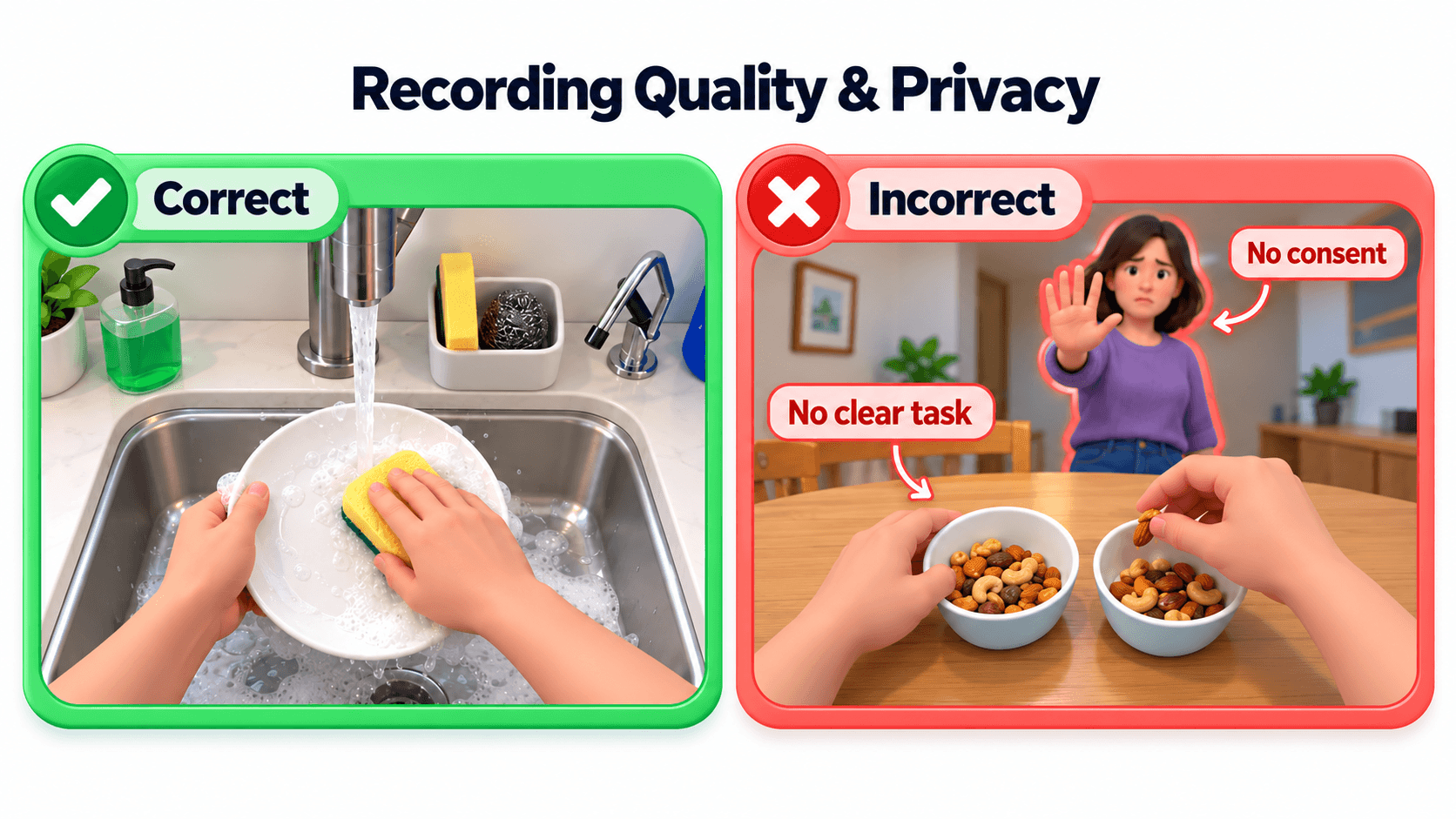
Reasons for rejection depend on the task. In first-person video data collection, requirements may cover the recording's content, the participant's behavior, and any information visible in the frame.
| What is checked | What may lead to rejection |
|---|---|
| Visibility of the action | Hands or objects leave the frame, or the camera angle makes the action difficult to understand |
| Practical purpose | The participant moves objects without a meaningful goal or pretends to perform a task |
| Repetition and idle time | A movement is prolonged unnecessarily, or waiting accounts for a substantial part of the recording |
| Natural movement | The participant keeps their hands in front of the camera continuously instead of performing the task naturally |
| Recording preparation | The camera has not been secured, or the participant adjusts it while recording |
| Authenticity | The participant films a video playing on a screen instead of recording their own actions |
| People and location | People appear without consent, children appear where prohibited, or recording takes place outside the authorized area |
| Sensitive information | Documents, passwords, identity documents, bank cards, or vehicle license plates are visible |
Some assignments also prohibit recording while seated or having any screens in view. These conditions must be stated explicitly in the instructions and acceptance criteria. Their applicability depends on the individual egocentric data project.
For example, a participant switches on a machine and waits 20 minutes for the process to finish. If the project requires active manipulation, that waiting time will not count toward the target volume. Alternatively, someone may start recording while holding the camera and secure it afterward. The opening segment will need to be removed or re-recorded, depending on the task requirements.
Even a strict specification cannot eliminate participant errors. The contractor bears the cost of its rejected footage and re-recording, factors those costs into the price, and allows time to replace rejected material.
Quality is also linked to diversity. An established team already knows the instructions. When participants and sites must change, training starts again, and the previous acceptance rate must be achieved with a new group.
Why Equipment Can Delay the Launch
In our projects, single-camera recording has gradually been supplemented by sensors, stereo cameras, and more complex capture systems. Each additional requirement affects procurement, shipping, and training.
The required device may be manufactured in China while collection takes place in South America. The team may be ready, but collection cannot begin until the equipment arrives.
Using multiple devices also introduces synchronization requirements: the camera and sensors need to represent the same moment in an action. Clock drift during recording must remain within the agreed tolerance. The Project Aria Gen 1 documentation describes one example of how such a system works. The appropriate tolerance for your project depends on the capture setup and task.
There is no universal markup for this added complexity. One supplier may already own the required cameras and know how to use them; another may need to buy everything and learn the workflow.
If a quote exceeds your budget, identify the main cost driver: equipment, participant recruitment, new sites, or re-recording. You can then discuss changes to the requirements where you have genuine flexibility.
What Free Samples Should Demonstrate
We begin with a few recordings made to your brief. In our experience, small samples are usually free, with the volume depending on the complexity of the request.
During the initial review, we check:
- Whether the environment and actions match the task.
- Whether the hands, objects, and outcome of the action are visible.
- Whether the recording contains pointless repetition, simulated work, or extended waiting.
- Whether the camera is mounted correctly and the participant follows the recording start procedure.
- Whether restrictions concerning people, recording locations, and sensitive information are met.
- Whether the files and accompanying data meet the technical requirements.
Sometimes a sample is so far from the brief that the discussion ends immediately. If the issue can be corrected, we explain it and review the next version.
The supplier's response to feedback is also revealing. If hands repeatedly leave the frame during a particular action, the camera mount, the participant's movement, or the instructions need to change. The next recording will show whether the correction worked.
A small volume is usually enough for initial screening. The ability to deliver quality data consistently is tested during the pilot.
Buying an off-the-shelf egocentric dataset requires a different approach. A few clips selected by the seller do not establish the condition of the entire dataset. Arrange access to a representative sample so you can perform your own checks.
Who Reviews the Data and Which Hours Do You Pay For?
We have worked with two models: the client receives raw footage and reviews it internally, or the supplier delivers data that has already passed its quality checks.
One client provided its own app. The app assigned tasks and controlled recording, and the data went directly to the client. Our team had no access to the recordings, so we could not review their content ourselves.
For another client, we built a workflow combining automated and manual review. In this model, the criteria and minimum acceptance rate are agreed in advance. The supplier needs to understand how much additional recording will be required to complete the order after accounting for rejected footage.
| Question | The buyer reviews raw footage | The supplier delivers reviewed data |
|---|---|---|
| Who performs the main selection? | The buyer's team | The supplier, before delivery |
| What is paid for? | The agreed raw volume | The volume and quality defined by the acceptance terms |
| Where are review costs accounted for? | In the buyer's internal costs | In the supplier's price, with the buyer retaining oversight |
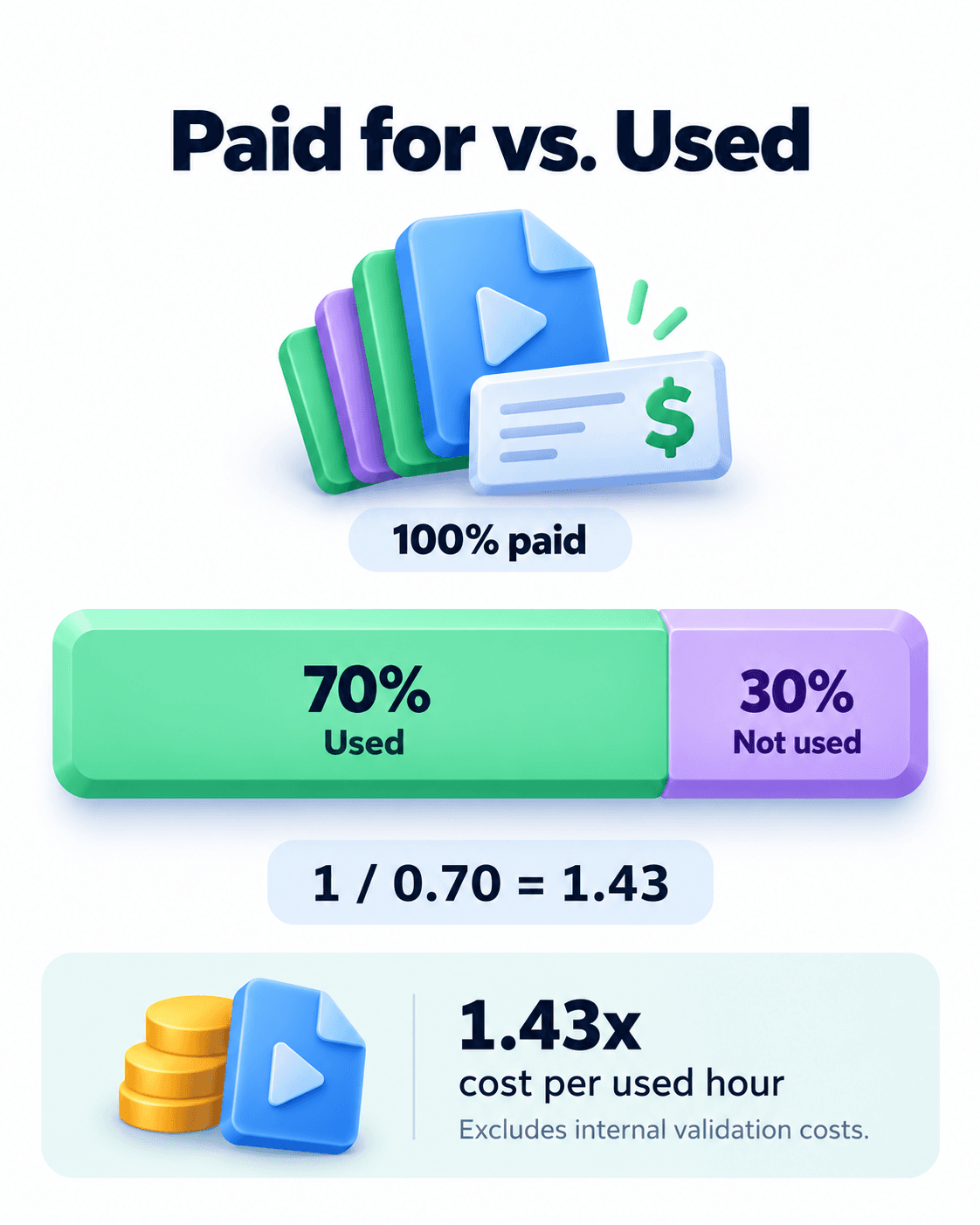
In one delivery, the client accepted and paid for all the footage, then later told us it had used 70%. The entire volume was accepted, but only part of it was suitable for the client's subsequent work.
In that case, the cost per used hour was 1.43 times the original hourly rate, before internal review costs. The 70% figure describes that specific delivery and should not be treated as a benchmark for other projects.
Calculation: paid hourly rate / share of footage used.
| Share of paid footage used | Cost per used hour as a multiple of the original rate |
|---|---|
| 100% | 1.00 |
| 90% | 1.11 |
| 80% | 1.25 |
| 70% | 1.43 |
The 100%, 90%, and 80% rows are illustrative scenarios.
A promise of "98% quality" also needs clarification. Which criteria were used to review the data? What counts as a defect? Is the percentage calculated by file, minute, or another unit? Technically sound recordings may still fail to meet the required actions or participant distribution.
Buyers need their own quality checks under either model. At the start of a relationship, review a substantial share of the footage. After several consistent deliveries, the amount of manual review can be reduced. Changes in sites, participants, or equipment are a reason to increase coverage again.
How to Agree on Data Rights and Recording Permissions
In our projects, participant consent and site permissions are arranged by the supplier at the lower level of the chain that works directly with the people and recording locations. This allocation of responsibilities needs to be agreed among the parties before collection begins.
The buyer needs to understand how consent is linked to specific recordings, which rights it receives, and what supporting documentation is included.
How Participants Give Consent
In one of our projects, recording took place through the client's app. Before recording began, each participant gave explicit electronic consent to the use of their data, and an email address was linked to their account. The recordings went directly to the client; we had no access to them.
This is one example of a project-specific process. Registration, consent confirmation, and record storage may work differently in another project.
Before launch, agree on:
- Who obtains participant consent and permission to record at the site.
- Where consent is recorded and how it is linked to the participant's ID.
- Who stores the supporting records and can provide them for review.
- What happens if someone who has not consented appears in the recording.
Participants themselves need to understand the last point. Consent from the person wearing the camera does not resolve the issue of colleagues, friends, or relatives appearing in the footage.
Which Rights the Buyer Receives
Our agreements often provide exclusive rights to the recordings. The precise scope of those rights and any restrictions are defined separately for each project.
Before collection begins, agree on permitted uses, whether the material can be shared with other project participants, and whether the supplier may retain or reuse it. The word "exclusivity" alone does not explain all of these conditions.
Discuss recording exclusivity and environmental diversity separately. A new video may be supplied exclusively to you while showing a factory already represented in your dataset.
How to Manage Access and Supporting Metadata
Handling personal and confidential information requires access controls, participant identifiers, and checks of what appears in the frame. Replacing a name with an ID does not, by itself, conceal a face, a document, or other identifiable information in the video.
Decide in advance who can access raw recordings and participant information, which material must be excluded from delivery, and whether additional processing is required. Rules prohibiting the recording of documents, passwords, and people without consent help reduce the problem at the capture stage.
Deliveries often include a table linking recordings to participants:
| Field | Purpose |
|---|---|
| Unique participant ID | Link recordings from the same person and check their contribution limit |
| Video ID | Identify each file unambiguously |
| Duration | Verify the delivery volume |
| Agreed metadata | Check required attributes, such as the task, environment type, or device configuration |
The table's contents depend on the buyer's objectives. Supporting records for consent and permissions must also be agreed separately. A video manifest alone does not establish the right to use the recordings.
How Budget and Payment Terms Affect Supplier Selection
Early in procurement, the question "How much would you charge to collect this?" often forms part of market research. The supplier provides a preliminary estimate and is usually not ready to invest in complex samples or reserve participants immediately.
When a buyer presents specific requirements, a volume, and a proposed price, the provider can assess the economics. The prospect of a large future order can sometimes justify a free pilot or an initial phase with very little margin.
In our experience, both the buyer's budget and the supplier's position in the chain influence the offer. Direct access to a large client gives a provider an opportunity to negotiate a higher rate. Pricing therefore also reflects the negotiating context.
If your budget is already set, you can share a target price. The supplier can then confirm feasibility or explain which requirement prevents it from meeting that price.
Payment timing also affects which suppliers can take on the work. Payment after delivery is common in the projects we handle. Until payment arrives, the supplier finances participants, sites, equipment, and the correction of rejected work.
A lengthy buyer validation process extends that period. The contractor has already delivered the footage, but the money needed to continue collection has not yet come back. These terms effectively favor companies with more working capital. A larger, more expensive supplier can sometimes become the only available option.
Shorter payment periods and payment by batch can make more local teams viable. Partial prepayment is also used for small projects that need to start quickly. For example, we have worked with a structure involving 50% upfront and payment of the balance afterward.
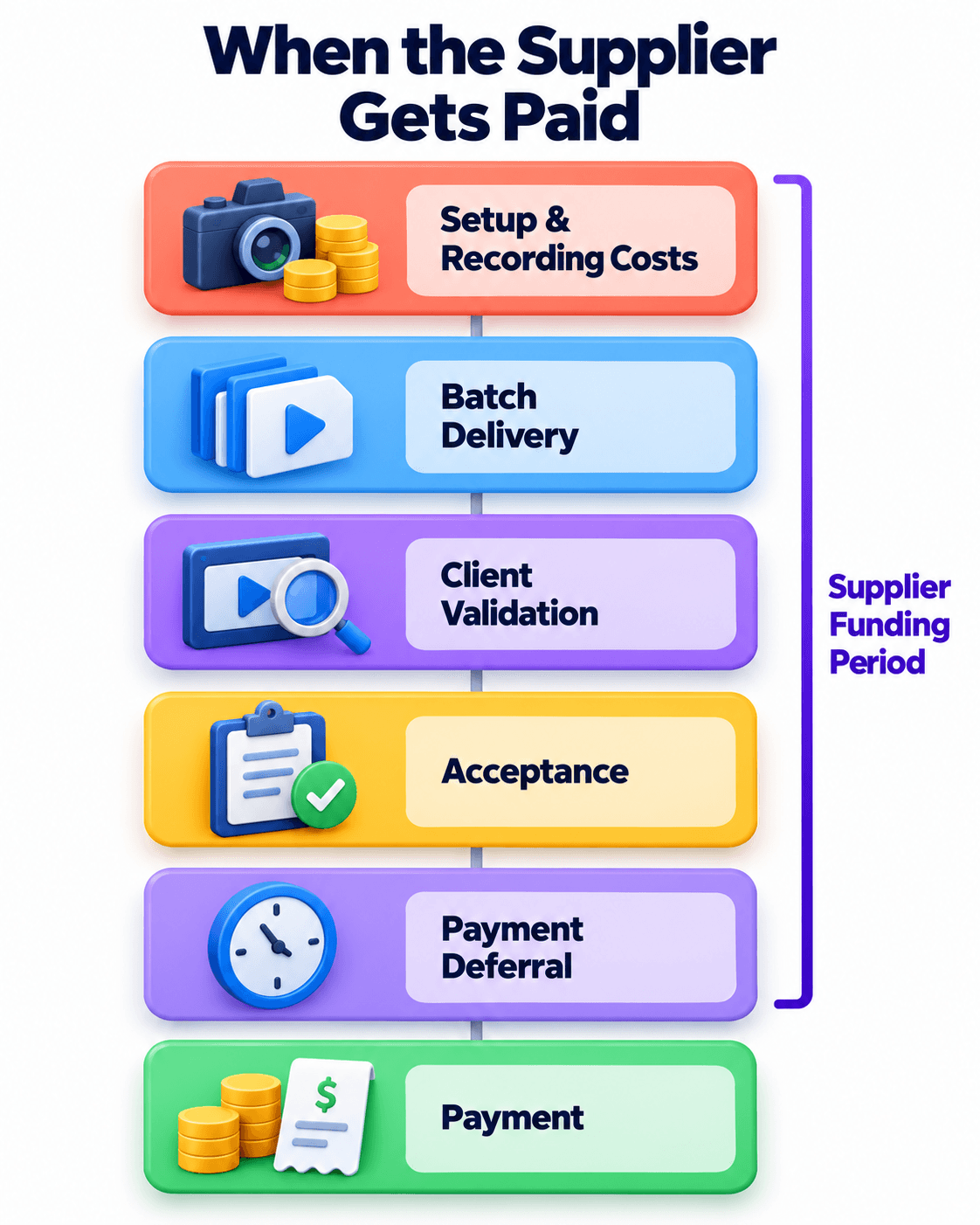
With payment after delivery, the contractor bears the main financial risk of funding an unsuccessful collection effort. The buyer spends time on setup and review, and its own plans depend on the delivery. Review timelines and payment frequency should therefore be discussed alongside the technical specification.
How to Avoid Buying the Same Data from Different Suppliers
Two suppliers may approach the same local collector. This creates two distinct risks for the end customer.
| What overlaps | What the buyer receives | What to establish |
|---|---|---|
| The recordings themselves | Material the buyer already has | Whether the recordings have already been supplied to the same end customer through another company |
| The environment | New videos from a familiar factory | Whether the environment provides the required diversity of sites and processes |
In the second case, the footage is genuinely new: a different shift, different participants, or a different date. However, the premises, equipment, and processes remain the same. If the objective was to increase diversity, this collection may fail to achieve it.
When sourcing contractors, we encounter local teams that have the right cameras and sites but are already working on a project whose details are protected by a nondisclosure agreement (NDA).
A statement such as "We work with a major AI lab" offers little help. Potential overlap needs to be addressed directly: has this site carried out similar collection for this end customer?
When working through an integrator, that question needs to reach the local provider. The company at the top of the chain may be unaware of the site's other projects. An NDA may also restrict the answer itself. We have not found a universal way to resolve this conflict; part of the assessment relies on information from the partner and trust in that relationship.
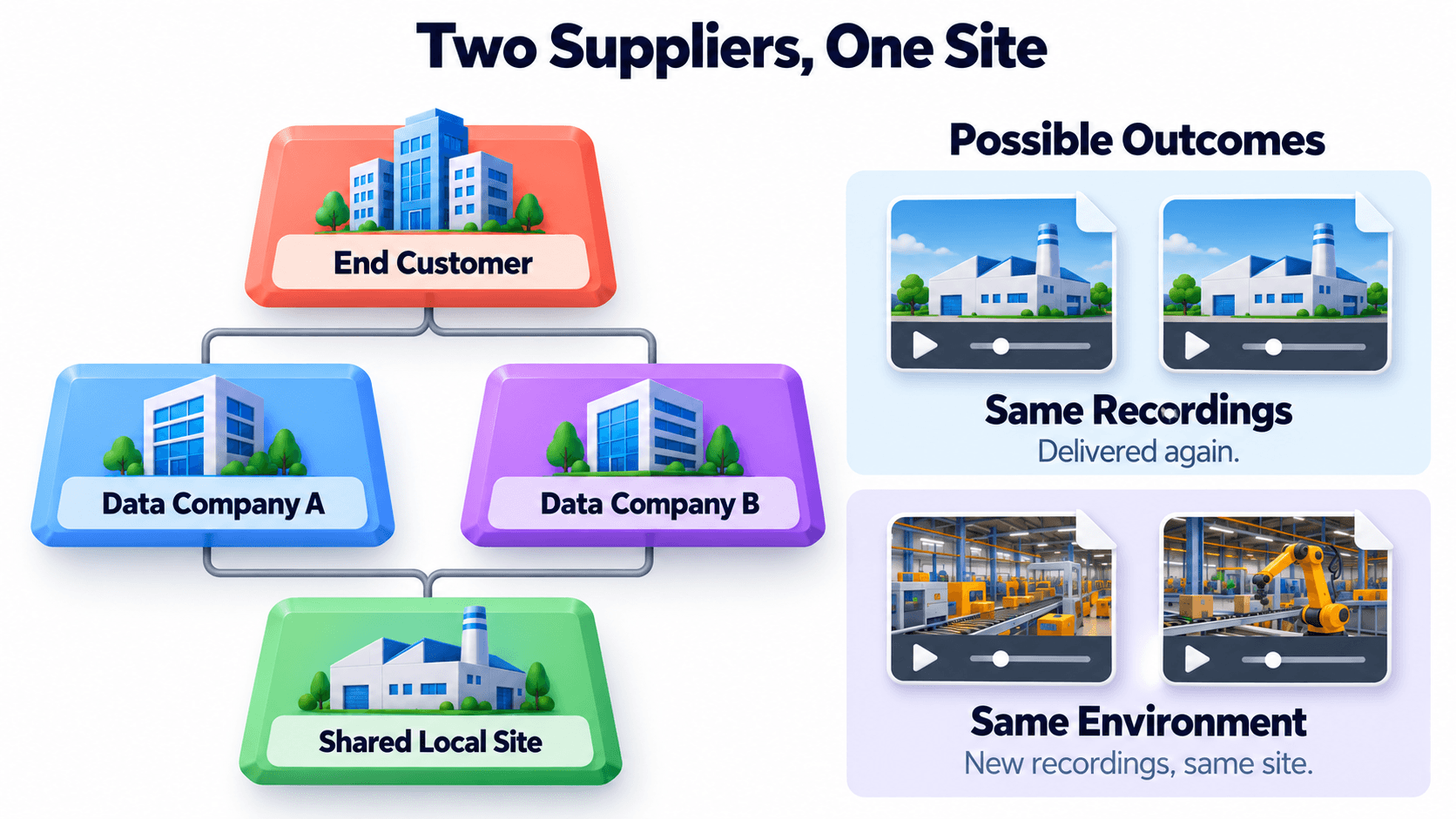
The delivery method affects the opportunity to reuse data. When recordings go directly into the client's app and the supplier cannot access them, the supplier has fewer opportunities to deliver the same material again. If it stores and prepares the files itself, compliance with reuse restrictions depends in part on access controls and operational discipline.
Even a new region does not guarantee that no one has previously collected data there for your project. Geography, recording exclusivity, and site overlap need to be checked separately.
How a Supplier Recovers a Delayed Project
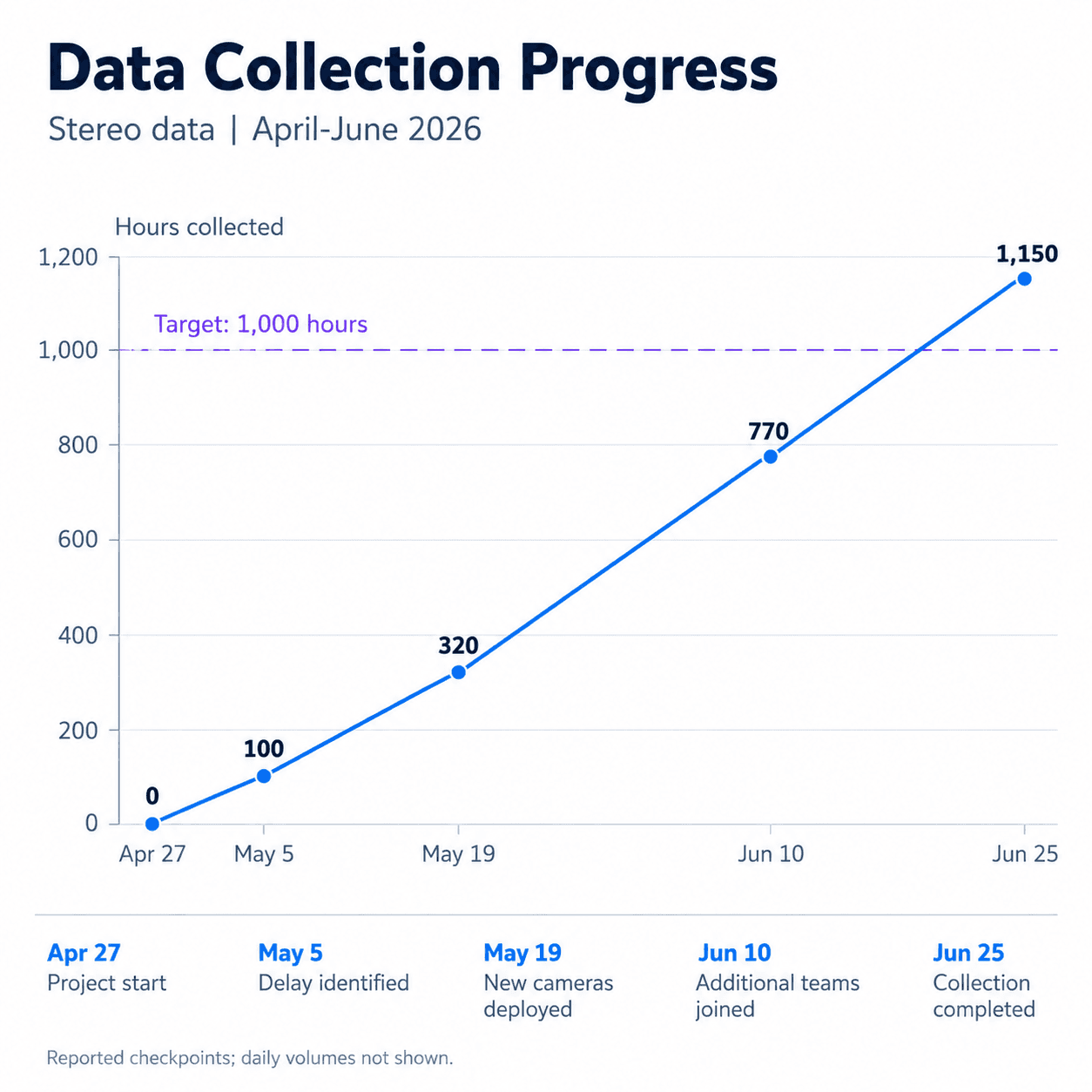
One of our projects required 1,000 hours of stereo data. By the time it became clear that the schedule was at risk, only 100 hours had been collected. Holidays in India and failures affecting some of the cameras disrupted collection. Finding replacements quickly proved difficult because teams with suitable devices were already busy.
To continue collection, we:
- Changed how we organized the process.
- Brought in several additional contractors.
- Purchased our own cameras.
We ultimately exceeded the target.
Ask a potential supplier to describe a similar case from its own experience: what happened, which resources it brought in, and what it achieved. The answer helps you assess the company's capabilities.
A small team may produce excellent recordings as long as its cameras keep working. A company with several partners and its own equipment has more ways to continue collection when something goes wrong. Part of its markup pays for that capacity.
For large collection projects in new countries, we send project managers to our partners. They assess the teams and locations and help organize equipment use. The buyer does not need to visit every site personally.
Another workable model involves BPO companies. A partner may have premises, supervisors, and experience managing staff, while lacking cameras and expertise in preparing robotics training data. The collection organizer supplies the equipment, technical workflow, quality checks, and delivery to the client.
Strict requirements for the country, facility type, or device make a struggling team harder to replace. Agree on acceptable substitutions before launch so that these discussions do not consume time when the project is already behind schedule.
How Large Should an Egocentric Data Collection Pilot Be?
Samples are followed by a pilot: a trial collection with a limited scope. It demonstrates quality and delivery rates across several batches, including the supplier's response to feedback.
I advise against committing the full volume of a large order to a new team immediately. Pilot size depends on the level at which the contract is placed.
| Contract relationship | Volumes from our experience |
|---|---|
| Contractor and subcontractor | 100, 200, 300, or 500 hours |
| Direct contract with a large end customer | 1,000 to 5,000 hours of egocentric data |
These figures do not establish a universal validation threshold. Pilot size and payment terms are agreed separately.
One of our projects began with a free 1,000-hour pilot. It was our first arrangement of that kind. We completed it on time and then signed a contract for 40,000 hours of paid collection.
In my view, a pilot of that size also tests the company's ability to finance collection. A small team may record well but lack the funds to meet such a high entry requirement. For a limited local project, requiring a large free pilot can exclude suitable providers.
Structure the pilot across several deliveries:
- Receive the first batch and review it against the agreed criteria.
- Provide specific feedback.
- Review the next batch to see whether the errors have been corrected and the required delivery rate is being maintained.
If diversity is a requirement, you need to see performance beyond a single convenient site. When one experienced team completes the entire pilot, the supplier's ability to onboard new participants remains untested.
Increase the order once you understand the actual acceptance rate, the rate of usable data delivery, and the supplier's response to errors. Subsequent volume should match demonstrated capacity and the plan for scaling.
What to Compare Before Choosing a Supplier
| What to compare | What should be clear before placing a large order |
|---|---|
| Position in the supply chain | Which responsibilities the company handles in return for its markup |
| Feasibility of requirements | Which restrictions increase costs, extend timelines, or prevent launch |
| Samples | Whether the supplier understands the brief and corrects specific errors |
| Billable volume | Which hours are paid for, who performs the review, and how acceptance is calculated |
| Rights and permissions | Who obtains consent, where supporting records are stored, and which rights the buyer receives |
| Delivery contents | How recordings are linked to participants and which metadata is included |
| Payment terms | Whether the supplier can finance collection through your review and payment periods |
| Data sources | Whether potential overlap in recordings and sites across suppliers has been checked |
| Operational resilience | Which teams and equipment are available as replacements when problems occur |
| Pilot | Whether quality, delivery rates, and responses to feedback have been demonstrated across several batches |
You can find candidates on the FileMarket map and directory, which lists data collection companies, facilities, and equipment providers. Select the relevant geography and data type, then send companies a brief covering the task, volume, mandatory restrictions, deadline, and budget if it has already been set. This gives you a basis for comparing proposals and discussing the first samples.